
The International Space Station (ISS) is a large, habitable research laboratory orbiting Earth in Low Earth Orbit (LEO)—approximately 400 km above the surface. It’s one of humankind’s greatest examples of global cooperation in science and technology.
The ISS was jointly developed and operated by NASA (USA), Roscosmos (Russia), JAXA (Japan), ESA (Europe), and CSA (Canada). It provides a distinctive setting for conducting microgravity research across various fields, including
- Physics and material science
- Space medicine and biology
- Earth observation and climate studies
- Plant growth and biotechnology
Essentially, it’s a living laboratory—a floating city of science—where astronauts and scientists work together to push the limits of human knowledge.
How Does the ISS Work?
The ISS orbits Earth once every 90 minutes, which means astronauts onboard experience 16 sunrises and sunsets every day.
Inside the station, astronauts:
- Conduct advanced experiments and research.
- Stay connected with Earth via radio, video calls, and satellite communication.
- Exercise daily to counter muscle and bone loss caused by microgravity.
Because gravity is nearly absent, daily activities like sleeping, eating, or even brushing teeth require special adaptation. Exercise machines are vital to maintain bone and muscle strength.
In short, the ISS is not just a spacecraft—it’s a global research platform beyond borders, combining technology, science, and human collaboration from across the world.
Check this– Simple Interest Questions with Solutions (MCQs)
Group Captain Shubhanshu Shukla—India’s New Star in Space
Early Life and Background
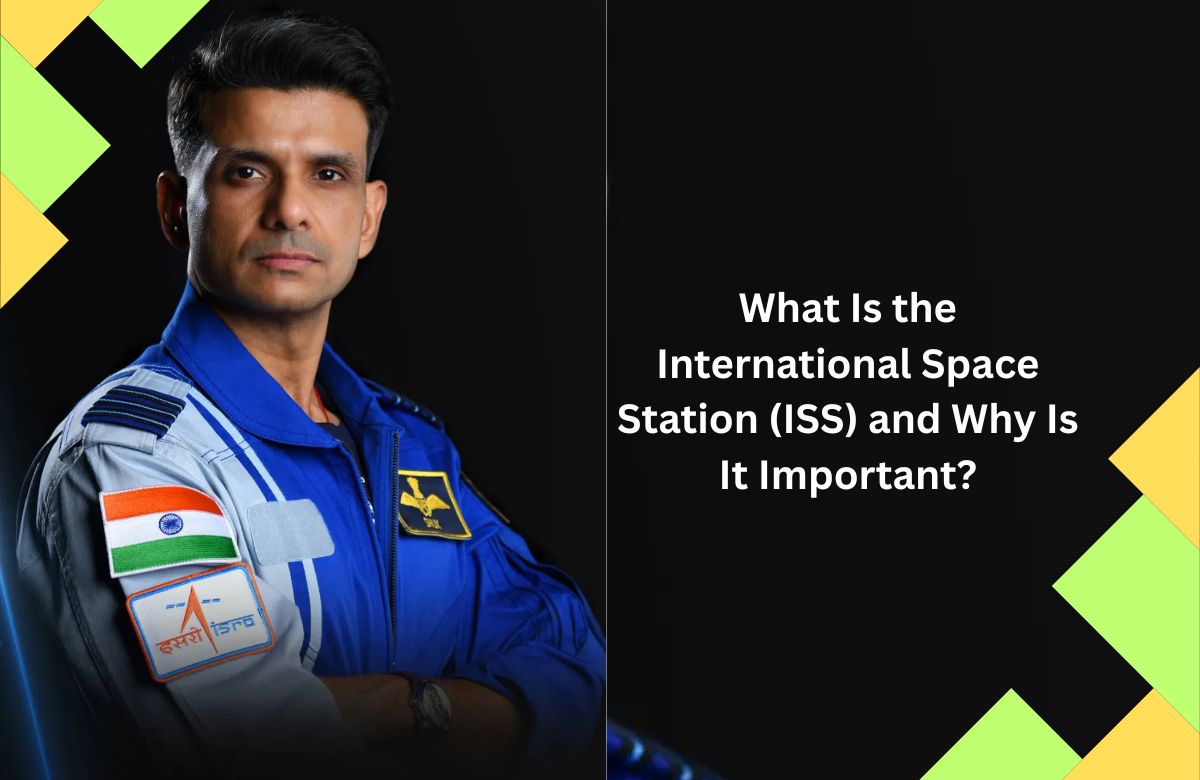
Born on October 10, 1985, in Lucknow, Group Captain Shubhanshu Shukla is an accomplished Indian Air Force test pilot. In 2019, he was selected among the first four astronauts for India’s human spaceflight program, Gaganyaan.
On June 25, 2025, he was launched aboard the Axiom Mission 4 (Ax-4)—becoming the first Indian astronaut to visit the International Space Station.
The Ax-4 Mission and His Experience
The Ax-4 mission, a collaboration between Axiom Space, SpaceX, and NASA, marked India’s historic entry into the ISS. Shukla served as the pilot aboard SpaceX’s Crew Dragon spacecraft, which successfully docked with the ISS.
He spent 18 days in orbit, conducting over 60 scientific experiments involving biology, physics, and plant science. His primary goal was to gather real-time data and insights that would benefit India’s future Gaganyaan human spaceflight program.
What Did He Say After Returning to Earth?
Upon returning, Shukla described his time in space as “a humbling reminder of how small and beautiful our planet really is.”
“From space, you don’t see borders or boundaries—just one blue and green world,” he said.
He also spoke about the challenges of microgravity—feeling lightheaded, losing balance, and adapting to weightlessness. Yet, with training and discipline, he successfully completed all assigned research tasks.
His work focused on microgravity’s effect on plant seeds, human tissue health, and biological responses, which will help shape future long-duration missions.
Why Is This Mission So Important for India?
After 41 years, an Indian astronaut once again traveled to space—and for the first time, to the ISS. Before Shukla, Rakesh Sharma had gone to space in 1984, but aboard the Soviet Salyut station, not the ISS.
This mission is a giant leap for India’s space ambitions:
- Strengthens India’s role in global space research.
- Provides invaluable experience for Gaganyaan and future deep-space missions.
- Inspires a generation of Indian students, scientists, and dreamers.
- Proves India’s capability to collaborate at the highest international level of science and technology.
When Shukla unfurled the Indian tricolor aboard the ISS and said, “Jai Hind, Jai Bharat!” it wasn’t just a salute—it was 1.4 billion dreams reaching beyond Earth’s horizon.
A New Dawn for India’s Space Science
Shubhanshu Shukla’s journey is more than a space mission—it’s a story of courage, vision, and national pride. His 18 days aboard the ISS mark the start of India’s next chapter in human spaceflight.
With every orbit, he carried not just experiments but the hope and ambition of an entire nation aiming for the stars.
Check this– Computer Related Question Answers [Computer, Internet & Android]